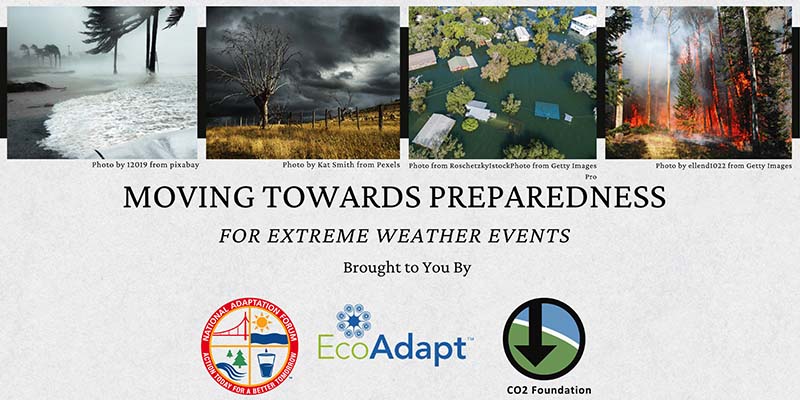



National Adaptation Forum Virtual Series: Moving Toward Preparedness for Extreme Weather Events
Session One: Enhancing the Preparedness and Resilience of Communities Before Disasters Strike: the Case of Texas, Florida, and Puerto Rico
Watch the recording here.
SPEAKERS
Cecilio Ortiz-Garcia, Professor, The University of Texas Rio Grande Valley
Marla Perez-Lugo, Professor, The University of Texas Rio Grande Valley
Ivis Garcia, Associate Professor, Texas A&M University
José Rodriguez, Deputy Director, Alianza Center
MODERATOR
Fernando I. Rivera, Director & Professor, Puerto Rico Research Hub- University of Central Florida
Session Two: The Importance of Small Business Continuity Planning When Preparing for Extreme Weather Events
Watch the recording here.
Business continuity planning is a critical and often overlooked component of extreme weather preparedness. In this session, hosted by the National Adaptation Forum's Virtual Forum, the speakers describe business continuity planning, why it’s important to community-level resilience, and share examples from across the country. Peter Plumeau (Reframe Lab) offers insights and examples from the “ClimateReadyVT” program, which helps Vermont small businesses create climate resilience strategies and action plans. ClimateReadyVT is hosted by Vermont Businesses for Social Responsibility (VBSR) and designed and facilitated by Reframe Lab, LLC. Tracie Sempier (Mississippi-Alabama Sea Grant Consortium) focuses on how your community can partner with local businesses to ensure they are ready for storm events utilizing a Business Continuity Plan (i.e., resources are staged before/after disaster events, flood zones are identified). Tracie discusses planning strategies to enhance a business’s ability to recover after natural or man-made disasters, including distribution of goods, cross-training staff, and obtaining necessary re-entry passes.
- Peter Plumeau, Partner, Reframe Lab
- Tracie Sempier, Resilience Engagement Lead, Mississippi-Alabama Sea Grant Consortium
- Daniella Rolle, National Adaptation Forum Program Associate, EcoAdapt and CivicSpark Fellow, CivicSpark
Session Three: Harvesting Strategies from the Agriculture Sector to Enhance Climate-Amplified Disaster Preparedness
Watch the recording here.
- Rose Olivas, Redford Fellow of Applied Research, Robert Redford Conservancy for California Sustainability, Pitzer College
- Dr. Rachel Schattman, Assistant Professor, University of Maine
- Daniella Rolle, National Adaptation Forum Program Associate, EcoAdapt and CivicSpark Fellow, CivicSpark
Session Four: Nature-Based Solutions as Adaptation to Extreme Weather
Watch the recording here.
- Merissa Zuzulock, Climate Resilience Integration Branch Chief, Federal Emergency Management Agency
- Whitney Boone, Acting Chief Policy Analyst, Office of Policy Analysis, Department of the Interior
- Margaret Kurth, Research Environmental Engineer, U.S. Army Engineer Research and Development Center
- Steven (Kyle) McKay, Senior Research Civil Engineer, U.S. Army Corps of Engineers
- Robyn De Young, Green Infrastructure Program Manager, Environmental Protection Agency
- Stephanie Santell, Senior Climate Advisor, Environmental Protection Agency
- Douglas Mason, Assistant Director of Nature Based Solutions, White House Office of Science and Technology Policy
Session Five: The Evidence for Nature-Based Solutions for Climate Hazard Risk Reduction
Watch the recording here.
Drawing on recent research and case studies, this session focuses on the growing body of evidence supporting nature-based solutions (NbS) as a promising approach to adapt to and mitigate the impacts of climate change. The session will include an interactive discussion where participants will break into working groups to identify actionable steps for scaling up the implementation of NbS and accelerating the learning process to improve their effectiveness in real-world applications.
Lara Hansen, Executive Director, EcoAdapt
Marta Vicarelli, Assistant Professor, University of Massachusetts Amherst
Doug Mason, Director, Millennium Challenge Corporation
- Daniella Rolle, National Adaptation Forum Program Associate, EcoAdapt and CivicSpark Fellow, CivicSpark